Make the screen do the work of causing the image to appear 3D, with two layers of screen, with polarising filters on the first one or something like that. The work of making the image 3D should be done by the projector and the screen, once, not N times by stupid spec's, where N = the number of people who want to see the effect. Besides, the specs don't work properly with some contact lenses and they are just generally stupid beyond belief. If you make millions out of this idea, send me some luncheon vouchers.
Kronk
Showing posts with label Kronk. Show all posts
Showing posts with label Kronk. Show all posts
Thursday, April 28, 2011


Sunday, May 16, 2010
Use concrete slabs to staunch Gulf of Mexico oil leak?
The idea is to keep adding concrete slabs till the flow is staunched on the same principle as first aid for an arterial bleed. The concrete slabs can be made rapidly as was done for system-built apartment blocks in the 1960's.
A tongue and groove system could be used to seal the edges and where the flat sides come together. The size of the panels would be geared to the capacity of the delivery machinery available. Would 10 x 10 x 2 ft be too heavy to put in place?
The result might be a partial pyramid, possibly 100 m2 with several interlocking and overlapping layers, as many as are needed so their weight exceeds the force of the gusher, in the same way that we are told to apply pressure to an arterial bleed, for example. The seabed might need levelling though, unless custom cast pieces can be created to fit to the existing topography.
|-------100m?-----|
*
An alternative approach might be to lower one absolutely massive piece of concrete onto the leak but such a heavy piece might not be manageable, in which case "the one piece" could be put together lego-like by lowering it down it in interlocking sections each on top of the previous - a bit similar to the tiling plan but with much bigger pieces over a smaller area.
Is it not the case that if you pressed a gusher like that forcefully enough that it could not continue? Why would this not work?
A tongue and groove system could be used to seal the edges and where the flat sides come together. The size of the panels would be geared to the capacity of the delivery machinery available. Would 10 x 10 x 2 ft be too heavy to put in place?
The result might be a partial pyramid, possibly 100 m2 with several interlocking and overlapping layers, as many as are needed so their weight exceeds the force of the gusher, in the same way that we are told to apply pressure to an arterial bleed, for example. The seabed might need levelling though, unless custom cast pieces can be created to fit to the existing topography.
|-------100m?-----|
___ ___
___ ___ ___
___ ___ ___ ___
___ ___ ___ ___ ___
( leak)
An alternative approach might be to lower one absolutely massive piece of concrete onto the leak but such a heavy piece might not be manageable, in which case "the one piece" could be put together lego-like by lowering it down it in interlocking sections each on top of the previous - a bit similar to the tiling plan but with much bigger pieces over a smaller area.
Is it not the case that if you pressed a gusher like that forcefully enough that it could not continue? Why would this not work?
Kronk
Friday, November 20, 2009
Grand unification theory questions
Einstein's formulae predict correctly how things will seem from different viewpoints (frames of reference). You can state what is measured from one point of view then feed in variables and calculate how the same event would seem from a different point of view. The idea that reality depended on point of view was and remains shocking but it is true, i.e. it works and accords with observable reality and has been proven by experiment. Although it describes a sort of mutability it is in its own way absolute in that it predicts exactly how events will be perceived.
Einstein's thoughts mainly had to do with things on a grand scale - light, time, planets, people and everyday objects but when it comes to the very tiny world of atoms and electrons, it seems that there is no such predictability. There is a finding called Heisenberg's Uncertainty Principle that says you cannot properly know about an atomic particle because by observing it you change it. There was a famous conference of the top physicists and theorists at which Einstein presented a thought experiment (an imagined experiment) that appeared to prove you could find out the mass of a particle at the same time as finding out its position, using a specially designed machine. However, on the next day of the conference another great scientist - Bohr? - pointed out a loophole that invalidated Einstein's thought experiment.
This troubled Einstein - he didn't accept it - and he spent most of his life trying to work out a way to reconcile his theory of Relativity and the apparently anomalous experimental evidence and conclusions of quantum (smallest possible scale) science. He said "God does not play dice." At other times he confirmed that he was an atheist, but he believed in a universe that follows set laws, rules that could be discovered and documented. He was trying to produce a new theory that would hold true at both the large scale and the quantum scale. Such a theory, one that would comprise a consistent set of rules that hold for all realms of science, is known as a Grand Unification Theory and is still being sought.
It was previously thought that electrons were particles that orbited around the nuclei of atoms but it is now known that they behave as if they are simultaneously all around the atom - smeared. Yet if "observed" or put into use, they will behave as particles. An electron is at the same time a wave and a particle, they say.
It seems to me that there is something in common between these two scientific theories, the conclusion that "different snapshots of the same thing" seem to comprise different realities. On the one hand it seems that X is the case but on the other hand it seems that Y is the case. For example in relativity on the one hand it seems that 20,000 years have gone by; on the other hand (for a space traveller travelling near the speed of light) it seems that only a few years have gone by. In quantum mechanics on the one hand it appears that a photon has gone through one slit in the apparatus, on the other it appears that it has gone through the other slit in the apparatus (in a device that tries to see which route a photon takes, which produces an inconclusive result).
In relativity an event in effect is more than one thing. To viewer A it is something but to viewer B it is something else. Yet there is only one event. In quantum mechanics a photon "is more than one thing". From a pattern seen on the surface of a detector it appears that the photon has gone through both slit A and slit B.
An electron is not in one location in orbit around a nucleus. But what does being in one location consist of for something that is moving - is it ever in one location? No, because it is moving - never in one location. So let us not be surprised that we cannot discover its location, especially as it is travelling at the speed of light - a speed at which time stands still. It is making its way from place to place but in no time. Therefore there is no time interval between it being in one place and the other, which in our terms comprises being in two places (N places) at the same time.
These particles participate in the very weft and warp of what reality is. It should not surprise us, therefore, that they appear miraculous since this whole dream of life is some sort of miracle. That there are elements that are in more than one place at the same time is no more amazing than any everyday event in life - all are equally miraculous. I doubt that anything people discover or describe will ever make life any less miraculous or mysterious.
The point I want to make is that this uncertainty of position is like relativity, it is a form of certainty, in that we know that these particles will be in more than one place at once. The whole question of where the electron is is an analogy of relativity's multiple viewpoints for the same event, where the electron is the event and the multiple locations are the multiple viewpoints.
Since this electron moves at the speed of light time stands still for it. "To the electron" no time passes, yet it moves from one location around the atom to another and therefore is in both places at once, since there is no time interval, there cannot be at the speed of light - when time "stands still". To the electron it is in more than one place at the same time. We cannot participate in this, so by trying to observe and detect this we disrupt it, effectively crash the electron. All we can see is a blur, which is the blur of a particle that is in the process of simultaneously being in more than one place at the same time.
Turning back to the idea that the multiple locations might be thought of as multiple observers of the electron, imagining that at several locations around the nucleus tiny observers could be placed who would have their impressions of where the electron was, they would all receive the same impression, that it was at their location all the time. What I want to ask is this: for these tiny imaginary observers observing the electron moving at the speed of light, and setting the speed of the observed object equal to the speed of light, will we not find that the laws and formulae of relativity do indeed apply and produce the same result for every tiny observer?
Whether or not the existing formulae apply, is it not the case that a set of formulae could be worked out that would correlate the multiple location impression, i.e. quantum uncertainty, with the "definite uncertainty" of relativity where what different observers will perceive can be calculated exactly? In effect is this not just a change to the variables whereby the event is moving at the speed of light and the observers are located in an orbital path of the event such that they all receive the same impression, despite their different locations. Can this quantum scenario not be derived by some transformation of Einstein's equations? (Where T=0?)
Kronk
Einstein's thoughts mainly had to do with things on a grand scale - light, time, planets, people and everyday objects but when it comes to the very tiny world of atoms and electrons, it seems that there is no such predictability. There is a finding called Heisenberg's Uncertainty Principle that says you cannot properly know about an atomic particle because by observing it you change it. There was a famous conference of the top physicists and theorists at which Einstein presented a thought experiment (an imagined experiment) that appeared to prove you could find out the mass of a particle at the same time as finding out its position, using a specially designed machine. However, on the next day of the conference another great scientist - Bohr? - pointed out a loophole that invalidated Einstein's thought experiment.
This troubled Einstein - he didn't accept it - and he spent most of his life trying to work out a way to reconcile his theory of Relativity and the apparently anomalous experimental evidence and conclusions of quantum (smallest possible scale) science. He said "God does not play dice." At other times he confirmed that he was an atheist, but he believed in a universe that follows set laws, rules that could be discovered and documented. He was trying to produce a new theory that would hold true at both the large scale and the quantum scale. Such a theory, one that would comprise a consistent set of rules that hold for all realms of science, is known as a Grand Unification Theory and is still being sought.
It was previously thought that electrons were particles that orbited around the nuclei of atoms but it is now known that they behave as if they are simultaneously all around the atom - smeared. Yet if "observed" or put into use, they will behave as particles. An electron is at the same time a wave and a particle, they say.
It seems to me that there is something in common between these two scientific theories, the conclusion that "different snapshots of the same thing" seem to comprise different realities. On the one hand it seems that X is the case but on the other hand it seems that Y is the case. For example in relativity on the one hand it seems that 20,000 years have gone by; on the other hand (for a space traveller travelling near the speed of light) it seems that only a few years have gone by. In quantum mechanics on the one hand it appears that a photon has gone through one slit in the apparatus, on the other it appears that it has gone through the other slit in the apparatus (in a device that tries to see which route a photon takes, which produces an inconclusive result).
In relativity an event in effect is more than one thing. To viewer A it is something but to viewer B it is something else. Yet there is only one event. In quantum mechanics a photon "is more than one thing". From a pattern seen on the surface of a detector it appears that the photon has gone through both slit A and slit B.
An electron is not in one location in orbit around a nucleus. But what does being in one location consist of for something that is moving - is it ever in one location? No, because it is moving - never in one location. So let us not be surprised that we cannot discover its location, especially as it is travelling at the speed of light - a speed at which time stands still. It is making its way from place to place but in no time. Therefore there is no time interval between it being in one place and the other, which in our terms comprises being in two places (N places) at the same time.
These particles participate in the very weft and warp of what reality is. It should not surprise us, therefore, that they appear miraculous since this whole dream of life is some sort of miracle. That there are elements that are in more than one place at the same time is no more amazing than any everyday event in life - all are equally miraculous. I doubt that anything people discover or describe will ever make life any less miraculous or mysterious.
The point I want to make is that this uncertainty of position is like relativity, it is a form of certainty, in that we know that these particles will be in more than one place at once. The whole question of where the electron is is an analogy of relativity's multiple viewpoints for the same event, where the electron is the event and the multiple locations are the multiple viewpoints.
Since this electron moves at the speed of light time stands still for it. "To the electron" no time passes, yet it moves from one location around the atom to another and therefore is in both places at once, since there is no time interval, there cannot be at the speed of light - when time "stands still". To the electron it is in more than one place at the same time. We cannot participate in this, so by trying to observe and detect this we disrupt it, effectively crash the electron. All we can see is a blur, which is the blur of a particle that is in the process of simultaneously being in more than one place at the same time.
Turning back to the idea that the multiple locations might be thought of as multiple observers of the electron, imagining that at several locations around the nucleus tiny observers could be placed who would have their impressions of where the electron was, they would all receive the same impression, that it was at their location all the time. What I want to ask is this: for these tiny imaginary observers observing the electron moving at the speed of light, and setting the speed of the observed object equal to the speed of light, will we not find that the laws and formulae of relativity do indeed apply and produce the same result for every tiny observer?
Whether or not the existing formulae apply, is it not the case that a set of formulae could be worked out that would correlate the multiple location impression, i.e. quantum uncertainty, with the "definite uncertainty" of relativity where what different observers will perceive can be calculated exactly? In effect is this not just a change to the variables whereby the event is moving at the speed of light and the observers are located in an orbital path of the event such that they all receive the same impression, despite their different locations. Can this quantum scenario not be derived by some transformation of Einstein's equations? (Where T=0?)
Kronk
Monday, July 27, 2009
Motorway
M40


The images of vertical things in the foreground are distorted, making them appear to lean in the direction of travel when photographed from a moving car. However things in the distance appear unaffected or not noticeably affected. Compare the fenceposts and pylons in the picture above.

I think I can rest my case after this example.

Just in case you still didn't believe it. (Can I label this science, Kronk?)
Ossian
Excellent experiment! I calculate that the car in question was travelling at approximately one tenth the speed of light, i.e. about 67 million mph. You need not worry however, as it would have been completely impossible for the speed cameras to read your license plate at that velocity. Kronk


The images of vertical things in the foreground are distorted, making them appear to lean in the direction of travel when photographed from a moving car. However things in the distance appear unaffected or not noticeably affected. Compare the fenceposts and pylons in the picture above.

I think I can rest my case after this example.

Just in case you still didn't believe it. (Can I label this science, Kronk?)
Ossian
Excellent experiment! I calculate that the car in question was travelling at approximately one tenth the speed of light, i.e. about 67 million mph. You need not worry however, as it would have been completely impossible for the speed cameras to read your license plate at that velocity. Kronk
Friday, July 17, 2009
Global warming to protect from solar cooling?
We've heard that the sun is at its lowest level for ages and that we might have another mini ice age, similar to the one about 300 years ago that lasted for what 20 years? (honestly I'm a blogger, I'm not paid to check all this - you can check for yourself). People went ice skating on the Thames and all that. At the same time we are told that greenhouse gases are going to cause the earth's temperature to rise. So what do we do faced with these marvellously counterbalanced changes? We say let's prevent the warming and have an ice age instead. This is purely from the point of view of "bloke in a pub". I don't really know anything about it but duh, no?
Kronk Pub Theories
Kronk Pub Theories
Thursday, April 09, 2009
Why are butterflies so beautiful?

Chalkhill Blue. Join the Great British Butterfly Hunt (Independent)
How does evolution explain the glorious patterning? Is there something in DNA that knows exactly how to place a line? It's not just butterflies, many plants and animals have lines and colours that seem designed for "aesthetic" effect. How on earth can that be encoded? - there simply isn't enough coding potential in the DNA system we're supposed to credit for it. How on earth, I repeat, can a plate full of amino acids resolve themselves not just into little robots, but into aesthetically drawn lines and colours, as well as living, wriggling, flitting, galloping creatures that put any imaginable battery power and programming completely nowhere by comparison. You can take any combination of chemicals you like and place them on any planet you like for however many million years, and you can pretty well guarantee that if you could come back in a billion years they'd still be sitting where you left them. They just don't do anything.
Laboratoires Kronk
Thursday, December 04, 2008
Time = expansion?
Horizon: Do you know what time it is? (BBC2)
Maybe the expansion of the universe, stretching or growing of interstellar space, either stretches or grows existence itself, creating the effect of time. Then if the universe stopped expanding, maybe there would only be space but no time. So my question is does expansion of space equate to duration?
We're told that the time referred to as the age of the universe, how long it has been since "the Big Bang", is all time during which the universe has been either stretching or growing, depending on whether you think space is being attenuated or increasing.
It is the medium of space, not matter that is being stretched, but matter is existing in a larger space the longer it exists. So each moment of existence is in either a progressively larger or progressively more stretched space. It could be either the feeling of space growing or the feeling of space being stretched that we know as time.
This thought came after watching the excellent Horizon program by Professor Brian Cox, who looks more like an emo pop singer than a professor.*
Helmut Kronk
<< Previous | Next >>
* It's one of those signs of aging when professors look like teenagers. (Time again!) Ed
Maybe the expansion of the universe, stretching or growing of interstellar space, either stretches or grows existence itself, creating the effect of time. Then if the universe stopped expanding, maybe there would only be space but no time. So my question is does expansion of space equate to duration?
We're told that the time referred to as the age of the universe, how long it has been since "the Big Bang", is all time during which the universe has been either stretching or growing, depending on whether you think space is being attenuated or increasing.
It is the medium of space, not matter that is being stretched, but matter is existing in a larger space the longer it exists. So each moment of existence is in either a progressively larger or progressively more stretched space. It could be either the feeling of space growing or the feeling of space being stretched that we know as time.
This thought came after watching the excellent Horizon program by Professor Brian Cox, who looks more like an emo pop singer than a professor.*
Helmut Kronk
<< Previous | Next >>
* It's one of those signs of aging when professors look like teenagers. (Time again!) Ed
Wednesday, September 24, 2008
It's those little hammers again
Large Hadron Collider Shut Down Until Spring 2009 "Full-power operation of the Large Hadron Collider (LHC) won't happen until early spring 2009, after an electrical glitch sparked a large helium leak inside the machine's tunnels." (National Geographic)
Electrical glitch my foot. It's like those archaeologists with their little hammers digging out skulls and proclaiming that all ancient people had their skulls smashed with little hammers. They've only gone and caused a rip in spacetime. It is no coincidence that the BBC's atomic clock missed a beat recently and then gave the signal for one hour later.
Laboratoire Kronk
Electrical glitch my foot. It's like those archaeologists with their little hammers digging out skulls and proclaiming that all ancient people had their skulls smashed with little hammers. They've only gone and caused a rip in spacetime. It is no coincidence that the BBC's atomic clock missed a beat recently and then gave the signal for one hour later.
Laboratoire Kronk
Wednesday, January 23, 2008
Solve obesity and energy crisis together
Eco-fitness
Why not provide people with exercise machines that generate electricity to power their houses? This would encourage people to exercise in the knowledge that they were saving money, helping the environment and improving their own health. Is there some reason why this could not help families work together to fight the obesity epidemic, and at the same time provide a sustainable source of energy?
<< Previous | Next >>
Professor Kronk
Why not provide people with exercise machines that generate electricity to power their houses? This would encourage people to exercise in the knowledge that they were saving money, helping the environment and improving their own health. Is there some reason why this could not help families work together to fight the obesity epidemic, and at the same time provide a sustainable source of energy?
<< Previous | Next >>
Professor Kronk
Friday, August 10, 2007
Science for the Confused - an occasional series
No. 6: Cracked record (reprise of no. 5)
I think I've said this before, but it's been on my mind again. The complexity of DNA is enough to account for the variations between individuals, but not enough to specify the pattern for the organism. Therefore DNA is probably only a series of variations to apply, but to what, we don't know. I have said it before, I remember now. It's like the instructions to a tailor: I want a blue suit, with a velvet collar and this and that measurement. It does not tell the tailor how to make a suit. And who is the tailor? What causes a plate of chemicals to turn into a human being? Or a banana? All these things with DNA, doesn't it mean that DNA is really synonymous with life? But there are more lines in a not-particularly-complicated computer program than there are in the human genome. So where is the real pattern for life? We can put a pile of amino acids in a saucer but they won't get up and write À la recherche du temps perdu.
Estimates vary from 25,000 to 80,000 effective genes in the human genome, and currently thought to be at the lower end of that range (ref: here). There are more parts in the body than there are elements in the genome! Imagine what it would need to program any one part of the body, never mind the brain, for example. You couldn't program even a wonky robot with that number of instructions, let alone a system to build a wonky robot (which, some might jokingly argue, is what we have).
<< Previous | Next >>
Prof. Kronk
Confused yet? You will be, here.
I think I've said this before, but it's been on my mind again. The complexity of DNA is enough to account for the variations between individuals, but not enough to specify the pattern for the organism. Therefore DNA is probably only a series of variations to apply, but to what, we don't know. I have said it before, I remember now. It's like the instructions to a tailor: I want a blue suit, with a velvet collar and this and that measurement. It does not tell the tailor how to make a suit. And who is the tailor? What causes a plate of chemicals to turn into a human being? Or a banana? All these things with DNA, doesn't it mean that DNA is really synonymous with life? But there are more lines in a not-particularly-complicated computer program than there are in the human genome. So where is the real pattern for life? We can put a pile of amino acids in a saucer but they won't get up and write À la recherche du temps perdu.
Estimates vary from 25,000 to 80,000 effective genes in the human genome, and currently thought to be at the lower end of that range (ref: here). There are more parts in the body than there are elements in the genome! Imagine what it would need to program any one part of the body, never mind the brain, for example. You couldn't program even a wonky robot with that number of instructions, let alone a system to build a wonky robot (which, some might jokingly argue, is what we have).
<< Previous | Next >>
Prof. Kronk
Confused yet? You will be, here.
Thursday, August 31, 2006
Juices 'may cut Alzheimer's risk'
Juices 'may cut Alzheimer's risk'
"They found the risk was 76% lower for those who drank juice more than three times a week, compared with those who drank it less than once a week." (BBC News)
This is another one of those "Duh" science stories, like our report about archaeologists breaking skulls with their little hammers and then saying that ancient people used to break each other's skulls.
Isn't it obvious that the people in the study who ended up suffering from Alzheimer's disease have only forgotten about all the fruit juice they drank? Scientists, please check with our Prof. Kronk before publishing results—he'll soon set you right.
<< Previous | Next >>
"They found the risk was 76% lower for those who drank juice more than three times a week, compared with those who drank it less than once a week." (BBC News)
This is another one of those "Duh" science stories, like our report about archaeologists breaking skulls with their little hammers and then saying that ancient people used to break each other's skulls.
Isn't it obvious that the people in the study who ended up suffering from Alzheimer's disease have only forgotten about all the fruit juice they drank? Scientists, please check with our Prof. Kronk before publishing results—he'll soon set you right.
<< Previous | Next >>
Saturday, July 01, 2006
Kronk's conjecture
That every physical entity is omni-dimensional.
We can imagine a one-dimensional object such as a line, or two-dimensional like a polygon but they cannot exist in our world as physical entities. We may represent them with fine drawing equipment but on microscopic examination the lines have height and width as well as length. Taking time as the fourth dimension, we can say that no physical object can exist which lacks one of the four dimensions. Without time there is no period in which to exist, without width there can be no length, without length there can be no height etc.
Therefore our experience suggests that nothing can exist without being present in all known dimensions. But something that is very large in one dimension may be very small in another. To explain "spooky action at a distance" then we can guess that the communication is via an extra dimension in which the distance is short.
A problem: to cut any object across one dimension—along the length, across the width etc.—as far as we can see results in two separate entities. But maybe our scissors are unable to cut through an extra dimension (time, for example) and the two apparently separate entities actually remain conjoined on the extra dimension.
Was this what I was thinking about when the guanabana fell? Ed?
<< Previous | Next >>
Kronk
We can imagine a one-dimensional object such as a line, or two-dimensional like a polygon but they cannot exist in our world as physical entities. We may represent them with fine drawing equipment but on microscopic examination the lines have height and width as well as length. Taking time as the fourth dimension, we can say that no physical object can exist which lacks one of the four dimensions. Without time there is no period in which to exist, without width there can be no length, without length there can be no height etc.
Therefore our experience suggests that nothing can exist without being present in all known dimensions. But something that is very large in one dimension may be very small in another. To explain "spooky action at a distance" then we can guess that the communication is via an extra dimension in which the distance is short.
A problem: to cut any object across one dimension—along the length, across the width etc.—as far as we can see results in two separate entities. But maybe our scissors are unable to cut through an extra dimension (time, for example) and the two apparently separate entities actually remain conjoined on the extra dimension.
Was this what I was thinking about when the guanabana fell? Ed?
<< Previous | Next >>
Kronk
Tuesday, June 27, 2006
Ask the professor
Letters

I remember seeing a program about twins on the television a few years ago in which one twin when he turned fifty, noticed that he had grown a single longer hair on the back of his left thumb above the knuckle. He phoned the other twin and asked him to check and sure enough the other twin also had grown a single longer hair in the same place. Now that I have turned fifty myself, I notice that I also have grown a single longer hair on the back of my left thumb above the knuckle, so it occurs to me that there must be a genetic trait to grow a single longer hair on the back of the left thumb above the knuckle when one turns fifty. Is this the case, and what could be the evolutionary advantage to it?
Mats Kelly, Dollis Hill
Professor Kronk Replies
Yes, you're quite correct, Mats. I too have developed the same thing, curled around in a loop. I can only assume it enables older individuals as they lose their wits, to differentiate their left hands from their right, thus enabling them to sign cheques faster and thereby purchase weapons more quickly than their evolutionary competitors. Those who accidentally pick up their pens with the wrong hand run the risk of being cut down with the newly bought swords of their left-thumb-haired adversaries, before they can complete the purchase of their own swords.*
<< Previous | Next >>
Kronk
* Like all great discoveries, it sounds so obvious now. Ed
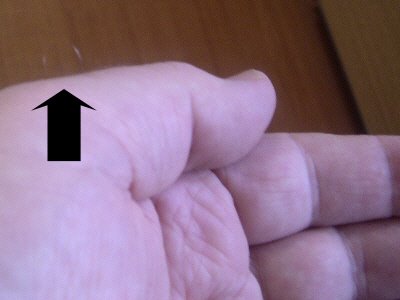
I remember seeing a program about twins on the television a few years ago in which one twin when he turned fifty, noticed that he had grown a single longer hair on the back of his left thumb above the knuckle. He phoned the other twin and asked him to check and sure enough the other twin also had grown a single longer hair in the same place. Now that I have turned fifty myself, I notice that I also have grown a single longer hair on the back of my left thumb above the knuckle, so it occurs to me that there must be a genetic trait to grow a single longer hair on the back of the left thumb above the knuckle when one turns fifty. Is this the case, and what could be the evolutionary advantage to it?
Mats Kelly, Dollis Hill
Professor Kronk Replies
Yes, you're quite correct, Mats. I too have developed the same thing, curled around in a loop. I can only assume it enables older individuals as they lose their wits, to differentiate their left hands from their right, thus enabling them to sign cheques faster and thereby purchase weapons more quickly than their evolutionary competitors. Those who accidentally pick up their pens with the wrong hand run the risk of being cut down with the newly bought swords of their left-thumb-haired adversaries, before they can complete the purchase of their own swords.*
<< Previous | Next >>
Kronk
* Like all great discoveries, it sounds so obvious now. Ed
Tuesday, June 13, 2006
Gardening roundup
Great excitement this evening with a silver and opalescent monsoon closing the recent heatwave. The naivest waves of cherry and apple blossom have long spent their weightless beauty and the once fearless lilacs have forgotten themselves and gone to seed. An embarrassment of popcorn white mayflowers quickly turned and fell, blushing pink speckles onto the grass.

Our camera crew rushed to capture the drama of a ladybird steeplejack patrolling the dawn white sprays of elderflower in the arboretum. The rampant and fecund elder has conjured these flowers from elaborate multi-candelabra podworks, and its show has only just begun.

The wild rose is everywhere tangled in the tall hedgerow of lilac, holly, forsythia, may and firethorn. And how could I omit forsythia, spring's first resplendent harbinger, from the chronology of inflorescence? Its yellow petals have been collected and made into languid catkins by the genteel laburnum, but-*
<< Previous | Next >>
Ganache
* I'm sorry to have to tell you that Ganache has been rushed to hospital with head injuries, after falling victim to a ten kilo soursop from the same tree in the greenhouse that nearly killed Prof. Kronk (causing him to forget the proof of his theorem, the law of the conservation of beauty). As much as we like it, I fear that either the soursop will have to be felled, or the bench relocated. Our best wishes for a speedy recovery go out to Ganache and his long time companion Velvan. Ed

Our camera crew rushed to capture the drama of a ladybird steeplejack patrolling the dawn white sprays of elderflower in the arboretum. The rampant and fecund elder has conjured these flowers from elaborate multi-candelabra podworks, and its show has only just begun.

The wild rose is everywhere tangled in the tall hedgerow of lilac, holly, forsythia, may and firethorn. And how could I omit forsythia, spring's first resplendent harbinger, from the chronology of inflorescence? Its yellow petals have been collected and made into languid catkins by the genteel laburnum, but-*
<< Previous | Next >>
Ganache
* I'm sorry to have to tell you that Ganache has been rushed to hospital with head injuries, after falling victim to a ten kilo soursop from the same tree in the greenhouse that nearly killed Prof. Kronk (causing him to forget the proof of his theorem, the law of the conservation of beauty). As much as we like it, I fear that either the soursop will have to be felled, or the bench relocated. Our best wishes for a speedy recovery go out to Ganache and his long time companion Velvan. Ed
Saturday, May 20, 2006
Scientific blunder
Britain was once a dangerous place to live
"Stone Age skulls from ancient mortuaries show that [between] 4000 and 3200 B.C., Britons had a 1-in-14 chance of being smashed over the head and those injured had a 1-in-50 chance of dying, a recent study reveals." (National Geographic)
Isn't it obvious that the archaeologists have damaged all the skulls with their little hammers. Have they never heard of Occam's razor? It's surprisingly handy for excavating ancient relics.
<< Previous | Next >>
Prof. Kronk
"Stone Age skulls from ancient mortuaries show that [between] 4000 and 3200 B.C., Britons had a 1-in-14 chance of being smashed over the head and those injured had a 1-in-50 chance of dying, a recent study reveals." (National Geographic)
Isn't it obvious that the archaeologists have damaged all the skulls with their little hammers. Have they never heard of Occam's razor? It's surprisingly handy for excavating ancient relics.
<< Previous | Next >>
Prof. Kronk
Wednesday, May 17, 2006
Science for the Confused - an occasional series
No. 5: DNA as a key not an engine
Intuitively it seems that there is not enough coded information in the human genome to account for the complexity of our bodies. [Insert plausible sounding reference here. Ed] But might there not be enough to account for our variations? We know that there are genes for hair colour, eye colour etc. It is often remarked that we have much more in common than we have different. But this begs the question, variation from what? In this scenario there must be an original pattern, much more complex than the "list of variations", and DNA is like the measurements we give a tailor who then makes a suit to measure. The suit is similar to all other suits, it only varies in respect of the details we gave to the tailor. Creationists would love to argue this if they haven't already, but the real implication is that there is another discovery to be made for which DNA is only the key*.
<< Previous | Next >>
Prof. H. Kronk (Science Correspondent)
* See "Comments" below for more. Kronk hypothesizes that the mother serves as the "complex original" template, whose variations arebacked out before applying replaced by the variations specified in the new individual's DNA. Ed
Intuitively it seems that there is not enough coded information in the human genome to account for the complexity of our bodies. [Insert plausible sounding reference here. Ed] But might there not be enough to account for our variations? We know that there are genes for hair colour, eye colour etc. It is often remarked that we have much more in common than we have different. But this begs the question, variation from what? In this scenario there must be an original pattern, much more complex than the "list of variations", and DNA is like the measurements we give a tailor who then makes a suit to measure. The suit is similar to all other suits, it only varies in respect of the details we gave to the tailor. Creationists would love to argue this if they haven't already, but the real implication is that there is another discovery to be made for which DNA is only the key*.
<< Previous | Next >>
Prof. H. Kronk (Science Correspondent)
* See "Comments" below for more. Kronk hypothesizes that the mother serves as the "complex original" template, whose variations are
Friday, January 13, 2006
Speeding cars menace
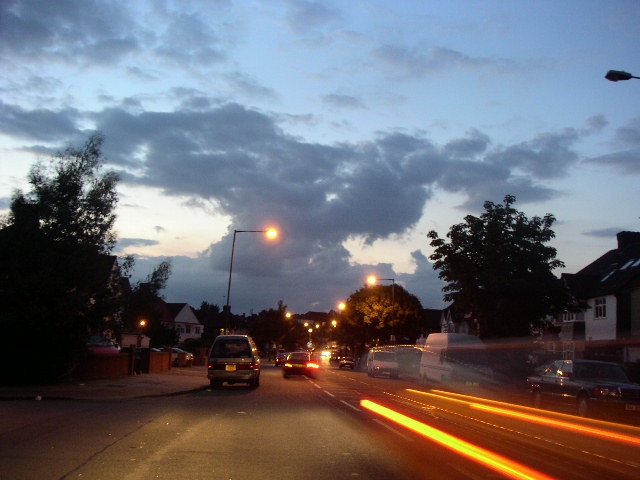
Herald science consultant, Prof. Kronk, estimates that the car in this picture must have been travelling at between 245 and 250 miles per hour.
Thursday, October 13, 2005
Now you don't see it, now you do
10m to study how to regrow damaged limbs
"Gus McGrouther, a plastic surgeon at Manchester University, said that while the research was in its early stages, the goal of regrowing limbs was not beyond human grasp. 'It's an achievable future, it will eventually happen.'"
The article doesn't mention that we can regrow the tips of our fingers. I (P Kronk, from the village W in the territory of L) have a guitarist friend who had the tip of one of his index fingers severed below the nail, and it has now grown back.*
Kronk
*Unfortunately, it has forgotten how to play its parts in my friend's guitar music.
"Gus McGrouther, a plastic surgeon at Manchester University, said that while the research was in its early stages, the goal of regrowing limbs was not beyond human grasp. 'It's an achievable future, it will eventually happen.'"
The article doesn't mention that we can regrow the tips of our fingers. I (P Kronk, from the village W in the territory of L) have a guitarist friend who had the tip of one of his index fingers severed below the nail, and it has now grown back.*
Kronk
*Unfortunately, it has forgotten how to play its parts in my friend's guitar music.
Tuesday, August 16, 2005
Dig it
The horror of scratching a blackboard with fingernails, and aversion to the horrible sound of grinding a pebble must come from the fact that fingernails and teeth have no feeling. Digging in the ground for roots, aversion to the sensation of scratching stone would protect one's fingers. When biting a peach the squeak of the tooth on stone is a warning to prevent damage. If the sound meant nothing we might damage our teeth. Were it not for the aversion to scratching a stone we might damage our fingers. Even thinking about these things "sets one's teeth on edge".
<< Previous | Next >>
Laboratoire Kronk Nailcare
Hear that Nature? New Scientist? Syndication enquiries: contact P. O'Toole. Ed
<< Previous | Next >>
Laboratoire Kronk Nailcare
Hear that Nature? New Scientist? Syndication enquiries: contact P. O'Toole. Ed
Wednesday, August 03, 2005
Subscribe to:
Posts (Atom)