Thursday, February 28, 2008
Pro Bono
A message from Comic Relief

"On behalf of everyone at Sport Relief we wanted to say an enormous thank you to Willesden Short Story Prize for sending us the £5,000 donation to Sport Relief 2008. ... £15 could buy a set of books for 3 street children in Bangladesh for a year. With an education these young people will be better equipped to get a job when they are older and thus escape from the cycle of poverty they would otherwise be trapped in. ... It just goes to show, the money you donated really will change lives and we couldn't do it without your support so keep up the good work." (Helen Kulbicki, National Fundraising). Thank you to all involved for their help. I think we can all be justifiably proud to have been part of something unusual and worthwhile. Steve Moran
Wednesday, February 27, 2008
The ghost of Sunday
Johnny Cash - Sunday Morning Coming Down
Could've turned for home, but just went on the warmer way
and I met the ghost of Sunday on the corner of Bryan Avenue.
A memory of malt and hops and roasted coffee
must have blown in from St James's Gate, all the way.
It wasn't there, just the memory and Johnny Cash
and the sleeping city sidewalk, not O'Connell Street
just a few sunlit squares of concrete all to myself.
--
Stephen Moran
<< Previous | Next >>
Monday, February 25, 2008

Leave Britney alone and leave Pincher Martin alone
Chris Crocker - LEAVE BRITNEY ZADIE SPEAKER MARTIN ALONE!
Letters
What a load of hot air about Speaker Martin's expenses! Surely the real public interest is in publicising these excellent schemes that he avails of, so we can all have a £17,000 housing allowance, not to mention a £4,000 taxi allowance for our spouses shopping expeditions. Surely the point is to level up not down? As soon as I can acquire the correct forms I shall be applying for the very same allowances. Why on earth would I want Speaker Martin fired? Catch yourselves on, people.
Alf Watt, Cricklewood
Thursday, February 21, 2008
Common faults in short stories submitted
(For a list of positive elements see The Sense of a Short Story)
Some people have expressed interest in knowing why entries in the Willesden Herald short story competition are eliminated or advanced, so I offer the following notes on why all but the last few are eliminated.
Writers need to realise that writing is like music: there is no getting away with bum notes. Think of the judging process as a series of auditions – X-Factor, American Idol, Young Musician of the Year, if you like. Now think of the hopeless cases. Out of tune: Next! Inept: Next! Hopelessly feeble: Next. Ego tripper: Next. An open competition is by definition a talent contest, and the entries can be imagined in the same way. But what are the bum notes, gaffes, misconceptions, delusions, ineptitudes in writing that are analogous to the failings of talent show entrants? Here are a few, not rearranged, but simply as they come to mind.
1. Failure to observe the rules. Let’s get this most boring reason for rejection of entries out of the way. In this year’s Willesden competition, the rule most breached was the one that specifies no author’s name on the manuscript. Not double-spaced or single-sided also featured, as well as missing or incomplete entry forms. Last, in both senses, were entries received after the closing date. Something approaching one in ten was eliminated for not complying with the rules. It is likely that some people took incomplete information from third party sites, so I recommend that you get the official rules and entry form from the competition website. Then follow the rules exactly, not approximately. Any entry that is not in compliance with the rules will be binned, unread.
2. Overcrowded with characters. Seán Ó Faoláin said a short story is to a novel as a hot air balloon is to a passenger jet. Like a jet the novel takes a long time to get off the ground, carries a lot of people and takes them a long way from where it started. On the other hand, the short story takes off vertically, rises directly to a great height, usually carries only one or two people, and lands not very far from where it took off. So when you mention three, four, five and sometimes even more names in the first two pages, it is inevitable that readers will be turned off (unless you have created a virtuosic masterpiece that defies all critique, such as Theresa's Wedding by William Trevor). Your story is likely to suffer from the following problem as well.
3. Undifferentiated characters. A name is not a character. Pinky said this, Perky said that, Blinky said something similar and Pisky said the same, as the old wartime song might have gone. Each character should be a complete person, with their own C.V. if you like, their own history, temperament, habits, weaknesses, plans, objectives etc, though these need not and should not be explicitly listed as such.
4. Solipsism. One miserable person being miserable. This was the most common and depressing failing. Unrelenting monotony of one single, invariably miserable and oppressive viewpoint. No sign of concern or even mention of any other character, nothing other than one person’s dreary moaning. If you are not interested in other characters, at least make it funny.
5. Well-enough written but I just don’t like it. This is the uncongenial protagonist or narrator, arrogant, cruel-minded, usually petty, often attempting gross-out effects, and usually going round in ever-diminishing circles before vanishing in a puff of studied triviality. It leaves a bad taste and invariably evokes the response that it’s well enough written, but I just don’t like it. There is no gun to the reader’s head. People do not read to be grossed out, or to join in somebody else’s squalor or misery. There has to be an element of transcendence, transmutation of the base material into the gold of fiction.
6. Throwaway endings. The story has been going along fairly well, showing signs of life and suddenly the writer must have thought, “Oh I can’t be bothered, I’m just going to put a twist here and finish it.” It’s literally almost impossible to believe sometimes why anybody would ever think of sending in something that is clearly truncated and given up on – what a waste of postage etc.
7. Over-elaborated endings. All has been going well, we’re hoping this might be a contender, we come to an excellent sign-off line, then woe, woe, thrice or four or five times woe for every extra sentence or paragraph that follows after that, telling us what should be left for us to decide for ourselves. So frustrating to hit one of these after reading all the way.
8. Throat-clearing openings. A build-up to the fact that we are about to hear a story, what it’s not about, what it is about, the fact that it starts here, the fact that it starts with something, the fact that it’s of a particular kind, the fact that you’re going to tell it. Cut, cut, cut. Then we come to the line where it really starts, but by then it’s too late: for something to get on a short list, it has to be virtually flawless and you’ve just started with a whopping great flaw.
9. Boring. “Middle of page 3 and I am totally bored.” “Well enough written but what is the point?” “I’m losing the will to live.” Again, the reader does not have a gun to his or her head. We have lives of our own. We don’t need to substitute somebody else’s dreary domestic arrangements in our minds for our own. To us, yours are far less interesting – and ours were not that interesting to start with. Who cares if somebody listened to a news story on the radio, went shopping, bought a packet of corn flakes? Yawn, yawn, yawn.
10. Banal. Commonplace, dull, the sort of thing you hear every day. This is really a continuation of “boring”. A lot of stories about elderly people living in squalor. A particularly English phenomenon. A lot of stories about dying relatives. Okay, but they better be good. It’s important to write about these things, but when you do you need to realise that there will be ten other people writing about the same thing, so you’d better make it very good. Life can be banal, but we turn to fiction to find – again –transcendence. This is more or less the same point that dead henry made in his “statement to the peasants”, which was so ill-received.
11. Mush. Mom and Pop and kiddie all having breakfast mush and school mush and boy and girl friend mush, car and scenery mush and all starting and ending up in a nostalgic sunset mush. I’ve given you English kitchen squalor, now I give you American kitchen mush. Both equally nauseating. I might as well add princess and frog fairytales in here.
12. Failed experiment. It’s fine and admirable to try an experimental format, but it’s not an excuse for slightness, skimpiness, overwriting, repetitiveness, underwriting, forced or boring content, or as often as not for semi-disguised or decorated solipsism, or any of the other failings listed here.
13. Unconvincing. Clunky or melodramatic. I just don’t buy it. This is fake, phoney baloney, unbelievable but presented as supposedly realistic. Often forced and plot-driven. Corny ending likely. Let’s add in here “routine police procedurals”, where hard-bitten Captain Craggy trades inscrutable comments on cases with eager tyro etc.
14. Weak premise. The triviality of some themes submitted is hard to believe. When you get a story that is 30 pages all about a minor ailment that has no apparent effects or significance, what are you to make of it? The writer is talking to himself, like one of those poor souls you can see on the high street any day. A sort of sub-category here is the “clever-sounding” element, that is like a lump of gristle in the apple pie of the story. Some people have a compulsion to mention things they have some specialist expertise about or simply know the names of, in a certain way that makes me think, “Go away.”
15. Not a short story. We don’t tell you what a short story is, you’re supposed to know. If you don’t know, tough. You need to go away and find out. I can tell you it’s not something over 220 pages long, as one entrant must have thought. Neither is it an essay. I presume people send in essays, thinking “Well it’s a long shot.” No it’s not a long shot, it’s a dud. Regardless of length a short story is not a mini-novel – a real tyro failing. The simplest advice is to read as many good short stories as you can and yours should be at home in their company – if you aspire to that. And if you don’t then why do you bother writing?
16. Full of errors. Slapdash spelling and grammatical errors are like bum notes in a musical audition. Even if you are a shining genius (as you all think you are) it is unlikely you will get away even with one. More than one and you’re stone dead. A lot of people who do not speak English seem to think they can find success in a short story competition with texts that contain errors in every sentence. Very rarely, there may be a story that is otherwise compelling but frustratingly riddled with errors.
17. Transparent attempt to pander to the judges. Every year we’ve had one or two (usually impossible) journeys in London, invariably ending up in Kilburn or Willesden. Try to see it from my point of view, imagine I open a guide book and try and write something about your city, where I’ve never lived – imagine the phoniness of the result. I would suggest you do not attempt to write to order for a competition. You can if you insist, but I can spot it a mile off and it is really off-putting. It just suggests that you have no real hinterland of your own.
18. Poor dialogue. Exposition of the story in dialogue is a common failing. “We must be very careful, as it is raining now and visibility is low.” “Yes, and it is cold. Ooh, look at the traffic there,” said Pinky. “Yes, there is a lot of it, isn’t there,” said Perky. “Look out! Elegant variation dead ahead”, muttered Pinky and exclaimed Perky simultaneously. Maybe you’ve heard somewhere that there has to be dialogue. What they didn’t add was, “not at any price.” If there is dialogue, it should be something that people really might say. Do not make your characters into ventriloquists dummies to tell your story through. There can be long passages without dialogue or there can be lots or a little dialogue. What there must not be is phoney dialogue. Another thing, if your characters are well enough defined, you should find that hardly any attribution is needed.
19. Unevenness. This includes unevenness of tone, pace, style and theme: parts of the story that are not in keeping with the rest, which should have been edited out or replaced. A story that starts out in one tone, maybe as a serious and really compelling story, then halfway through turns into a facetious spoof. A digression from the main theme that makes the reader think, "What is that doing here?". I think there was one entry we received that seemed to be three short shorts stuck together. More slapdashery. Remember: it’s like music – you can’t “get away" with anything. With most competitions it should be safe to assume you are writing for/playing your music for people who can say in all modesty that they are not tone deaf.
20. Summation. "All in the past" syndrome. This is a problem sometimes characterised as “undepicted action” or “telling instead of showing.” Most writers seem to have a grasp of the need to get attention at the beginning, but an astonishing number by the middle of page two have started to tell us all about some ancient family history. All sense of immediacy and story is lost and instead we’re having summaries of complex events that happened, one sentence each, like a dry and tedious history book.
21. Underwriting and overwriting. Too sketchy or too long-winded. I get the impression that the long-winded are probably more pleased with themselves, but they’re no more popular with readers than the skimpers – rather the reverse. Cut out as much as you can, without cutting into the quick, and you’ll find that your text will improve. Isaac Babel said that our writing becomes stronger, not when we can add no more but when we can take nothing more away. The skimpy efforts are just rushed, undercooked, choose your own metaphor. I’m sure we know when we have underwritten (I include myself), so why do we waste postage sending underwritten pieces out?
22. Unicorns and elves, chick lit, police procedurals and bodice rippers. These should only be submitted to specialist competitions for their specific genres. The Willesden is for so-called literary stories. It’s not a pleasing term, so I would rather say non-generic stories. (I think Joyce once said that the word “literature” was used as a term of abuse.) Readers will not get beyond the first line of - and they are invariably labelled thus - the Prologue: “Nervelda gazed on the mistfields of Thuriber. Her green eyes glinted in the slanting sun, as the tribes of Godnomore straggled over the barren land.” Lord and Lady Farquahar and their servants will journey in vain to quaint villages full of worthy and unworthy peasants. I think I’ve already mentioned Inspector Craggy (promoted in the sequel) and his eager sidekicks. As for chick lit: in reading as well as in life, we may be partial to a bit of office romance, but about ten or twenty of them later and they begin to pall.
23. Faux jollity. Particularly faux jollity centred around pubs, and particularly around pubs in Ireland. Industrially extruded quantities of guff about distant histories in small town life. Standing jokes that should have been left where they toppled. Weird spastic prose as if the task of writing the story had been given by a writer with a good idea to the former class dunce, now barman. I think humour only ever exists in something that sets out to be serious. Anything that sets out to be humorous is doomed.
24. Ankles in Asia. I've changed my mind on this one. As a matter of fact, I’m not at all sure that Ankles in Asia, though it now sounds worryingly like a rare disease, is not in fact a virtue. Let a thousand professors dream of butterfly kisses with a thousand feisty young neighbour girls.
25. Clumsiness. Proliferation of unnecessary commas. Awkward mis-edited clauses, unintentional rhymes, pedestrian, dull prose, infantile expressions, over formality ("Mr Smith had a reputation as bit of a disciplinarian. Miss Elma Furblong often thought that, while thinking about what to get to ease the hunger pangs in her tummy.") Stuffiness generally. Let's save a few more categories and add here out-of-date literary sensibilities and pretensions, the aphoristic, portentous, pompous, didactic and polemical. If I think of any more I'll most likely add them into this catch-all category.
25. Clichéd. I'm thinking mostly of clichéd expressions. If I said I'm thinking "by and large" of clichéd expressions, that would be an example in itself. It's usually little clumps of words that always seem to go together, but also whole concepts that go unquestioned. Cities are always bustling, sunsets always golden, looks always stern etc. The Irish poet Jean O'Brien said (in a workshop I attended) "Beware of the bits that seem to write themselves." In avoiding clichés it is the underlying assumptions that have to be dispelled. A "translated cliché" would still be a cliché.
26. Unspeakable. "Actors call some lines pills to swallow, for they cannot be made to sound genuine" is an example of this syndrome. Maybe it's just me, but I find the use of the word "for" instead of "because" archaic and laboured. I tend to think that if I wouldn't use the word in speech then I shouldn't in writing. I wouldn't say "I think it's very cold today for the pond is frozen" so why write it? Anything that would sound laboured if read out has to go. You probably recognise the dismal effect when somebody says something and "it sounds like they're reading it out". If I write: "The solution to this problem is to read everything aloud first" that in itself contains an example of the problem. If I read out that sentence, it sounds like I'm reading it out. Maybe it's acceptable in an after-dinner speech, but it's death to a story. It breaks the spell. (How might it be improved, the injunction to read aloud? How could it be phrased better? It just doesn't sound right, maybe this way would work: "A good way to find parts that sound clunky is to read things aloud when you're editing.")
27. Pastiche. There can be cases where the whole story is a cliché, if you see what I mean, which is usually to say that it is derivative in the extreme. It might be deliberately writing to a formula, or it might be lacking a genuine "voice". I'm very impressed by people who can emulate other writers to a tee, which can be brilliant, but I find it difficult enough just "to write like myself". Here's a little story: When I was a kid I used to sing myself to sleep at night. We used to go see films in the Casino cinema in Finglas (Dublin), and occasionally there would be a musical. I remember on one of those nights when I began to sing in bed, trying to sound like the singer one of those musicals. Then I asked my Grandad, who slept on the other side of the room, if he liked my new voice. I always remember his answer and I thought about it a lot. He said, "I prefer your own voice."
In summary, when there are hundreds of entries to a short story competition, only a story that is near as dammit technically flawless has a chance of reaching the short list. As you know, there are still more qualities beyond technical perfection that are required. In a world class orchestra every musician is technically perfect, leaving them free to work on interpretation and expressivity. With stories I suppose it's subtle resonances and other quasi-poetic elements in the layering of words, a sense of adventure, newness etc - another list to think about for another day.
I've just added another three categories of fault, a couple of days after posting the first draft of this, and a list of books* stopping short of literary theory, philosophy of language and suchlike. In the Willesden short story competition we’re not asking for high philosophy – dead henry might be, I can’t really say, though he has been compared with Baudrillard – but we are looking for something technically perfect, original, vivid and compelling in serious or humorous non-generic stories. Exactly how or why these come into existence may always remain a mystery but they do.
Steve Moran
P.S. I should add that every single entry was a valiant effort. It's a labour of love to read them as it must have been to write them, when most of us have full working days and only the tired few hours remaining to devote to writing. I only wrote the list of points above to be helpful and to open my own thoughts and prejudices to constructive criticism. I think, and always think every year, that all the writers who entered showed talent and potential, and that among the stories were many "near misses".
* Some books about writing
Short Circuit - A Guide to the Art of the Short Story, edited by Vanessa Gebbie
The First Five Pages (Noah Lukeman, Prentice Hall)
On Writing (Stephen King, New English Library)
Dreaming by the Book - Elaine Scarry (Actually, this one is somewhat "high philosophy"/cerebral.)
Writer's Workshop - by Stephen Koch
Bird by Bird (Anne Lamott, Anchor Books)
Update: An earlier version of this article appeared in:
The New Writer’s Handbook II, (Scarletta Press)
A Practical Anthology of Best Advice for Your Craft and Career
preface by Ted Kooser, edited by Philip Martin
Writing/Reference, $16.95
6” x 9”, 288 pages, softcover
ISBN: 978-0-9798249-2-0
Publication date: August 2008
About the short story
The Lonely Voice (Frank O'Connor, Melville House)
A few interesting links
Belief and Technique for Modern Prose (Jack Kerouac)
A Short History of the Short Story (William Boyd)
Principles of a Story (Raymond Carver)
Updated: 30/11/2008, 21/2/2009, 12/6/2009, 20/6/2009, 22/8/2018
Some people have expressed interest in knowing why entries in the Willesden Herald short story competition are eliminated or advanced, so I offer the following notes on why all but the last few are eliminated.
Writers need to realise that writing is like music: there is no getting away with bum notes. Think of the judging process as a series of auditions – X-Factor, American Idol, Young Musician of the Year, if you like. Now think of the hopeless cases. Out of tune: Next! Inept: Next! Hopelessly feeble: Next. Ego tripper: Next. An open competition is by definition a talent contest, and the entries can be imagined in the same way. But what are the bum notes, gaffes, misconceptions, delusions, ineptitudes in writing that are analogous to the failings of talent show entrants? Here are a few, not rearranged, but simply as they come to mind.
1. Failure to observe the rules. Let’s get this most boring reason for rejection of entries out of the way. In this year’s Willesden competition, the rule most breached was the one that specifies no author’s name on the manuscript. Not double-spaced or single-sided also featured, as well as missing or incomplete entry forms. Last, in both senses, were entries received after the closing date. Something approaching one in ten was eliminated for not complying with the rules. It is likely that some people took incomplete information from third party sites, so I recommend that you get the official rules and entry form from the competition website. Then follow the rules exactly, not approximately. Any entry that is not in compliance with the rules will be binned, unread.
2. Overcrowded with characters. Seán Ó Faoláin said a short story is to a novel as a hot air balloon is to a passenger jet. Like a jet the novel takes a long time to get off the ground, carries a lot of people and takes them a long way from where it started. On the other hand, the short story takes off vertically, rises directly to a great height, usually carries only one or two people, and lands not very far from where it took off. So when you mention three, four, five and sometimes even more names in the first two pages, it is inevitable that readers will be turned off (unless you have created a virtuosic masterpiece that defies all critique, such as Theresa's Wedding by William Trevor). Your story is likely to suffer from the following problem as well.
3. Undifferentiated characters. A name is not a character. Pinky said this, Perky said that, Blinky said something similar and Pisky said the same, as the old wartime song might have gone. Each character should be a complete person, with their own C.V. if you like, their own history, temperament, habits, weaknesses, plans, objectives etc, though these need not and should not be explicitly listed as such.
4. Solipsism. One miserable person being miserable. This was the most common and depressing failing. Unrelenting monotony of one single, invariably miserable and oppressive viewpoint. No sign of concern or even mention of any other character, nothing other than one person’s dreary moaning. If you are not interested in other characters, at least make it funny.
5. Well-enough written but I just don’t like it. This is the uncongenial protagonist or narrator, arrogant, cruel-minded, usually petty, often attempting gross-out effects, and usually going round in ever-diminishing circles before vanishing in a puff of studied triviality. It leaves a bad taste and invariably evokes the response that it’s well enough written, but I just don’t like it. There is no gun to the reader’s head. People do not read to be grossed out, or to join in somebody else’s squalor or misery. There has to be an element of transcendence, transmutation of the base material into the gold of fiction.
6. Throwaway endings. The story has been going along fairly well, showing signs of life and suddenly the writer must have thought, “Oh I can’t be bothered, I’m just going to put a twist here and finish it.” It’s literally almost impossible to believe sometimes why anybody would ever think of sending in something that is clearly truncated and given up on – what a waste of postage etc.
7. Over-elaborated endings. All has been going well, we’re hoping this might be a contender, we come to an excellent sign-off line, then woe, woe, thrice or four or five times woe for every extra sentence or paragraph that follows after that, telling us what should be left for us to decide for ourselves. So frustrating to hit one of these after reading all the way.
8. Throat-clearing openings. A build-up to the fact that we are about to hear a story, what it’s not about, what it is about, the fact that it starts here, the fact that it starts with something, the fact that it’s of a particular kind, the fact that you’re going to tell it. Cut, cut, cut. Then we come to the line where it really starts, but by then it’s too late: for something to get on a short list, it has to be virtually flawless and you’ve just started with a whopping great flaw.
9. Boring. “Middle of page 3 and I am totally bored.” “Well enough written but what is the point?” “I’m losing the will to live.” Again, the reader does not have a gun to his or her head. We have lives of our own. We don’t need to substitute somebody else’s dreary domestic arrangements in our minds for our own. To us, yours are far less interesting – and ours were not that interesting to start with. Who cares if somebody listened to a news story on the radio, went shopping, bought a packet of corn flakes? Yawn, yawn, yawn.
10. Banal. Commonplace, dull, the sort of thing you hear every day. This is really a continuation of “boring”. A lot of stories about elderly people living in squalor. A particularly English phenomenon. A lot of stories about dying relatives. Okay, but they better be good. It’s important to write about these things, but when you do you need to realise that there will be ten other people writing about the same thing, so you’d better make it very good. Life can be banal, but we turn to fiction to find – again –transcendence. This is more or less the same point that dead henry made in his “statement to the peasants”, which was so ill-received.
11. Mush. Mom and Pop and kiddie all having breakfast mush and school mush and boy and girl friend mush, car and scenery mush and all starting and ending up in a nostalgic sunset mush. I’ve given you English kitchen squalor, now I give you American kitchen mush. Both equally nauseating. I might as well add princess and frog fairytales in here.
12. Failed experiment. It’s fine and admirable to try an experimental format, but it’s not an excuse for slightness, skimpiness, overwriting, repetitiveness, underwriting, forced or boring content, or as often as not for semi-disguised or decorated solipsism, or any of the other failings listed here.
13. Unconvincing. Clunky or melodramatic. I just don’t buy it. This is fake, phoney baloney, unbelievable but presented as supposedly realistic. Often forced and plot-driven. Corny ending likely. Let’s add in here “routine police procedurals”, where hard-bitten Captain Craggy trades inscrutable comments on cases with eager tyro etc.
14. Weak premise. The triviality of some themes submitted is hard to believe. When you get a story that is 30 pages all about a minor ailment that has no apparent effects or significance, what are you to make of it? The writer is talking to himself, like one of those poor souls you can see on the high street any day. A sort of sub-category here is the “clever-sounding” element, that is like a lump of gristle in the apple pie of the story. Some people have a compulsion to mention things they have some specialist expertise about or simply know the names of, in a certain way that makes me think, “Go away.”
15. Not a short story. We don’t tell you what a short story is, you’re supposed to know. If you don’t know, tough. You need to go away and find out. I can tell you it’s not something over 220 pages long, as one entrant must have thought. Neither is it an essay. I presume people send in essays, thinking “Well it’s a long shot.” No it’s not a long shot, it’s a dud. Regardless of length a short story is not a mini-novel – a real tyro failing. The simplest advice is to read as many good short stories as you can and yours should be at home in their company – if you aspire to that. And if you don’t then why do you bother writing?
16. Full of errors. Slapdash spelling and grammatical errors are like bum notes in a musical audition. Even if you are a shining genius (as you all think you are) it is unlikely you will get away even with one. More than one and you’re stone dead. A lot of people who do not speak English seem to think they can find success in a short story competition with texts that contain errors in every sentence. Very rarely, there may be a story that is otherwise compelling but frustratingly riddled with errors.
17. Transparent attempt to pander to the judges. Every year we’ve had one or two (usually impossible) journeys in London, invariably ending up in Kilburn or Willesden. Try to see it from my point of view, imagine I open a guide book and try and write something about your city, where I’ve never lived – imagine the phoniness of the result. I would suggest you do not attempt to write to order for a competition. You can if you insist, but I can spot it a mile off and it is really off-putting. It just suggests that you have no real hinterland of your own.
18. Poor dialogue. Exposition of the story in dialogue is a common failing. “We must be very careful, as it is raining now and visibility is low.” “Yes, and it is cold. Ooh, look at the traffic there,” said Pinky. “Yes, there is a lot of it, isn’t there,” said Perky. “Look out! Elegant variation dead ahead”, muttered Pinky and exclaimed Perky simultaneously. Maybe you’ve heard somewhere that there has to be dialogue. What they didn’t add was, “not at any price.” If there is dialogue, it should be something that people really might say. Do not make your characters into ventriloquists dummies to tell your story through. There can be long passages without dialogue or there can be lots or a little dialogue. What there must not be is phoney dialogue. Another thing, if your characters are well enough defined, you should find that hardly any attribution is needed.
19. Unevenness. This includes unevenness of tone, pace, style and theme: parts of the story that are not in keeping with the rest, which should have been edited out or replaced. A story that starts out in one tone, maybe as a serious and really compelling story, then halfway through turns into a facetious spoof. A digression from the main theme that makes the reader think, "What is that doing here?". I think there was one entry we received that seemed to be three short shorts stuck together. More slapdashery. Remember: it’s like music – you can’t “get away" with anything. With most competitions it should be safe to assume you are writing for/playing your music for people who can say in all modesty that they are not tone deaf.
20. Summation. "All in the past" syndrome. This is a problem sometimes characterised as “undepicted action” or “telling instead of showing.” Most writers seem to have a grasp of the need to get attention at the beginning, but an astonishing number by the middle of page two have started to tell us all about some ancient family history. All sense of immediacy and story is lost and instead we’re having summaries of complex events that happened, one sentence each, like a dry and tedious history book.
21. Underwriting and overwriting. Too sketchy or too long-winded. I get the impression that the long-winded are probably more pleased with themselves, but they’re no more popular with readers than the skimpers – rather the reverse. Cut out as much as you can, without cutting into the quick, and you’ll find that your text will improve. Isaac Babel said that our writing becomes stronger, not when we can add no more but when we can take nothing more away. The skimpy efforts are just rushed, undercooked, choose your own metaphor. I’m sure we know when we have underwritten (I include myself), so why do we waste postage sending underwritten pieces out?
22. Unicorns and elves, chick lit, police procedurals and bodice rippers. These should only be submitted to specialist competitions for their specific genres. The Willesden is for so-called literary stories. It’s not a pleasing term, so I would rather say non-generic stories. (I think Joyce once said that the word “literature” was used as a term of abuse.) Readers will not get beyond the first line of - and they are invariably labelled thus - the Prologue: “Nervelda gazed on the mistfields of Thuriber. Her green eyes glinted in the slanting sun, as the tribes of Godnomore straggled over the barren land.” Lord and Lady Farquahar and their servants will journey in vain to quaint villages full of worthy and unworthy peasants. I think I’ve already mentioned Inspector Craggy (promoted in the sequel) and his eager sidekicks. As for chick lit: in reading as well as in life, we may be partial to a bit of office romance, but about ten or twenty of them later and they begin to pall.
23. Faux jollity. Particularly faux jollity centred around pubs, and particularly around pubs in Ireland. Industrially extruded quantities of guff about distant histories in small town life. Standing jokes that should have been left where they toppled. Weird spastic prose as if the task of writing the story had been given by a writer with a good idea to the former class dunce, now barman. I think humour only ever exists in something that sets out to be serious. Anything that sets out to be humorous is doomed.
24. Ankles in Asia. I've changed my mind on this one. As a matter of fact, I’m not at all sure that Ankles in Asia, though it now sounds worryingly like a rare disease, is not in fact a virtue. Let a thousand professors dream of butterfly kisses with a thousand feisty young neighbour girls.
25. Clumsiness. Proliferation of unnecessary commas. Awkward mis-edited clauses, unintentional rhymes, pedestrian, dull prose, infantile expressions, over formality ("Mr Smith had a reputation as bit of a disciplinarian. Miss Elma Furblong often thought that, while thinking about what to get to ease the hunger pangs in her tummy.") Stuffiness generally. Let's save a few more categories and add here out-of-date literary sensibilities and pretensions, the aphoristic, portentous, pompous, didactic and polemical. If I think of any more I'll most likely add them into this catch-all category.
25. Clichéd. I'm thinking mostly of clichéd expressions. If I said I'm thinking "by and large" of clichéd expressions, that would be an example in itself. It's usually little clumps of words that always seem to go together, but also whole concepts that go unquestioned. Cities are always bustling, sunsets always golden, looks always stern etc. The Irish poet Jean O'Brien said (in a workshop I attended) "Beware of the bits that seem to write themselves." In avoiding clichés it is the underlying assumptions that have to be dispelled. A "translated cliché" would still be a cliché.
26. Unspeakable. "Actors call some lines pills to swallow, for they cannot be made to sound genuine" is an example of this syndrome. Maybe it's just me, but I find the use of the word "for" instead of "because" archaic and laboured. I tend to think that if I wouldn't use the word in speech then I shouldn't in writing. I wouldn't say "I think it's very cold today for the pond is frozen" so why write it? Anything that would sound laboured if read out has to go. You probably recognise the dismal effect when somebody says something and "it sounds like they're reading it out". If I write: "The solution to this problem is to read everything aloud first" that in itself contains an example of the problem. If I read out that sentence, it sounds like I'm reading it out. Maybe it's acceptable in an after-dinner speech, but it's death to a story. It breaks the spell. (How might it be improved, the injunction to read aloud? How could it be phrased better? It just doesn't sound right, maybe this way would work: "A good way to find parts that sound clunky is to read things aloud when you're editing.")
27. Pastiche. There can be cases where the whole story is a cliché, if you see what I mean, which is usually to say that it is derivative in the extreme. It might be deliberately writing to a formula, or it might be lacking a genuine "voice". I'm very impressed by people who can emulate other writers to a tee, which can be brilliant, but I find it difficult enough just "to write like myself". Here's a little story: When I was a kid I used to sing myself to sleep at night. We used to go see films in the Casino cinema in Finglas (Dublin), and occasionally there would be a musical. I remember on one of those nights when I began to sing in bed, trying to sound like the singer one of those musicals. Then I asked my Grandad, who slept on the other side of the room, if he liked my new voice. I always remember his answer and I thought about it a lot. He said, "I prefer your own voice."
In summary, when there are hundreds of entries to a short story competition, only a story that is near as dammit technically flawless has a chance of reaching the short list. As you know, there are still more qualities beyond technical perfection that are required. In a world class orchestra every musician is technically perfect, leaving them free to work on interpretation and expressivity. With stories I suppose it's subtle resonances and other quasi-poetic elements in the layering of words, a sense of adventure, newness etc - another list to think about for another day.
I've just added another three categories of fault, a couple of days after posting the first draft of this, and a list of books* stopping short of literary theory, philosophy of language and suchlike. In the Willesden short story competition we’re not asking for high philosophy – dead henry might be, I can’t really say, though he has been compared with Baudrillard – but we are looking for something technically perfect, original, vivid and compelling in serious or humorous non-generic stories. Exactly how or why these come into existence may always remain a mystery but they do.
Steve Moran
P.S. I should add that every single entry was a valiant effort. It's a labour of love to read them as it must have been to write them, when most of us have full working days and only the tired few hours remaining to devote to writing. I only wrote the list of points above to be helpful and to open my own thoughts and prejudices to constructive criticism. I think, and always think every year, that all the writers who entered showed talent and potential, and that among the stories were many "near misses".
* Some books about writing
Short Circuit - A Guide to the Art of the Short Story, edited by Vanessa Gebbie
The First Five Pages (Noah Lukeman, Prentice Hall)
On Writing (Stephen King, New English Library)
Dreaming by the Book - Elaine Scarry (Actually, this one is somewhat "high philosophy"/cerebral.)
Writer's Workshop - by Stephen Koch
Bird by Bird (Anne Lamott, Anchor Books)
Update: An earlier version of this article appeared in:
The New Writer’s Handbook II, (Scarletta Press)
A Practical Anthology of Best Advice for Your Craft and Career
preface by Ted Kooser, edited by Philip Martin
Writing/Reference, $16.95
6” x 9”, 288 pages, softcover
ISBN: 978-0-9798249-2-0
Publication date: August 2008
About the short story
The Lonely Voice (Frank O'Connor, Melville House)
A few interesting links
Belief and Technique for Modern Prose (Jack Kerouac)
A Short History of the Short Story (William Boyd)
Principles of a Story (Raymond Carver)
Updated: 30/11/2008, 21/2/2009, 12/6/2009, 20/6/2009, 22/8/2018


Wednesday, February 20, 2008
Newsmusic - Weird fishes
Weird fishes discovered in Antarctic ocean (National Geographic)
Where else can you get music tracks matched to news of scientific discoveries? Nowhere, that's where.
Newsmusic Desk
Radiohead - Weird Fishes/ Arpeggi (Scotch Mist Version). Radiohead/ YouTube official
Tuesday, February 19, 2008


Hail and farewell
We're sorry to see you go, Ossian, but we all understand that there are things that are more important in life even than writing for the top local international newspaper. So take all the time you need, and we won't change your password, your login will be here waiting and your desk - actually, can we have your desk for our new staffer Orlick Zuker? I don't think you'll mind. But we'll find you another when you come back. Take care of yourself. On behalf of the entire staff.
Feargal Mooney
Feargal Mooney
Monday, February 18, 2008
Bye for now
I need to take some time off from being a newspaper tycoon, and just go through some personal matters for a while. What is it they always say, just before they hit you? This is going to hurt me more than it hurts you. Maybe summer?
Ossian Carey-Lennon
Ossian Carey-Lennon
Sunday, February 17, 2008
Careless words cost jibes
A Warning About Blog Comments
"This is a very funny story (albeit embarrassing) that involves the New Zealander Katherine Mansfield, who is considered by many to be one of the greatest short story writers of the 20th century. This is also a warning about the comments we leave on the web, and the growing problem of how comments that are meant to be humorous/ironic can be misinterpreted and taken too seriously. I certainly never expected that one of my recent comments on a blog would result in a false report in The Sunday Times, a national newspaper in Britain. Cripes! Let me explain..." (Shameless Words)
Blogdesk Team
"This is a very funny story (albeit embarrassing) that involves the New Zealander Katherine Mansfield, who is considered by many to be one of the greatest short story writers of the 20th century. This is also a warning about the comments we leave on the web, and the growing problem of how comments that are meant to be humorous/ironic can be misinterpreted and taken too seriously. I certainly never expected that one of my recent comments on a blog would result in a false report in The Sunday Times, a national newspaper in Britain. Cripes! Let me explain..." (Shameless Words)
Blogdesk Team
Yes we can.
"A host of celebrities including actress Scarlett Johansson, jazz legend Herbie Hancock, and retired basketball player Kareem Abdul-Jabbar take part in the music video 'Yes We Can' for Barack Obama's campaign." (Telegraph)
Feargal Mooney
Friday, February 15, 2008
Book listings update
Our proprietor Red Woodward has never seen a penny from the Amazon listings over there. [Update, July 2008: Recently received £12.89 Amazon Associates commission. Unfortunately reinvested it all in a business in Cheltenham that failed to come in. Red] When last checked there was about 50 pence built up in the Amazon Associates account, too small an amount to transfer.
Anyway, now that that hilarity is out of the way, the listings have been updated with books by some of our previous years' short story competition finalists: "Bed" by Tao Lin (Melville House, 2007), "Seven Loves" by Valerie Trueblood (Sphere, 2007), "To the World of Men, Welcome" by Nuala Ní Chonchúir (Arlen House, 2005), "One Note Symphonies" by Sean Brijbasi (Pretend Genius Press, 2007), "Show Me the Sky" by Nicholas Hogg (Canongate, 2008) and "Words from a Glass Bubble" by Vanessa Gebbie (Salt, 2008). The last one was short-listed under a pen name, but that's by the by (or who by the who by, if you prefer).
"Is This What You Want?" (Bloomsbury, 2007) is the anthology of the Asham Award competition, which kindly posts an online link to ours. Their anthology also contains commissioned stories.
Just as composers who wrote songs have also given us chamber music, concertos and symphonies, writers of short stories are as likely as not to compose poetry, novellas and novels too. That is by way of introducing another of the books listed, "Last Night's Dream Corrected" an anthology of poetry. It includes poems by Willesden short story competition winner and finalist Mikey Delgado and Raewyn Alexander, respectively. I think it is the book of which I am proudest and fondest. It also has poetry by noted poets Joanne Kyger, Bill Berkson and others. (Amazon wrongly lists editor Feargal Mooney as author.)
The anthologies "Fish Drink Like Us" and "New Short Stories 1" contain some of the winning and short-listed stories from 2006 and 2007. The remaining books are by local authors, contacts and friends of the competition and not forgetting "The Children of Willesden Lane".
"Ice Bears and Kotick" is an amazing true adventure account of the first ever circumnavigation of the Arctic island of Spitsbergen in an open rowing boat. The author was featured recently on national radio (BBC Radio 4). You can meet and hear Peter Webb and see slides from his record-making journey, at The Space, Willesden Library Centre, from 8 pm on Thursday February 28th, courtesy of our friends in the Willesden Green Writers' Workshop and Brent Libraries. (This replaces the previously advertised event.)
Ossian
Anyway, now that that hilarity is out of the way, the listings have been updated with books by some of our previous years' short story competition finalists: "Bed" by Tao Lin (Melville House, 2007), "Seven Loves" by Valerie Trueblood (Sphere, 2007), "To the World of Men, Welcome" by Nuala Ní Chonchúir (Arlen House, 2005), "One Note Symphonies" by Sean Brijbasi (Pretend Genius Press, 2007), "Show Me the Sky" by Nicholas Hogg (Canongate, 2008) and "Words from a Glass Bubble" by Vanessa Gebbie (Salt, 2008). The last one was short-listed under a pen name, but that's by the by (or who by the who by, if you prefer).
"Is This What You Want?" (Bloomsbury, 2007) is the anthology of the Asham Award competition, which kindly posts an online link to ours. Their anthology also contains commissioned stories.
Just as composers who wrote songs have also given us chamber music, concertos and symphonies, writers of short stories are as likely as not to compose poetry, novellas and novels too. That is by way of introducing another of the books listed, "Last Night's Dream Corrected" an anthology of poetry. It includes poems by Willesden short story competition winner and finalist Mikey Delgado and Raewyn Alexander, respectively. I think it is the book of which I am proudest and fondest. It also has poetry by noted poets Joanne Kyger, Bill Berkson and others. (Amazon wrongly lists editor Feargal Mooney as author.)
The anthologies "Fish Drink Like Us" and "New Short Stories 1" contain some of the winning and short-listed stories from 2006 and 2007. The remaining books are by local authors, contacts and friends of the competition and not forgetting "The Children of Willesden Lane".
"Ice Bears and Kotick" is an amazing true adventure account of the first ever circumnavigation of the Arctic island of Spitsbergen in an open rowing boat. The author was featured recently on national radio (BBC Radio 4). You can meet and hear Peter Webb and see slides from his record-making journey, at The Space, Willesden Library Centre, from 8 pm on Thursday February 28th, courtesy of our friends in the Willesden Green Writers' Workshop and Brent Libraries. (This replaces the previously advertised event.)
Ossian
Thursday, February 14, 2008
Future's past
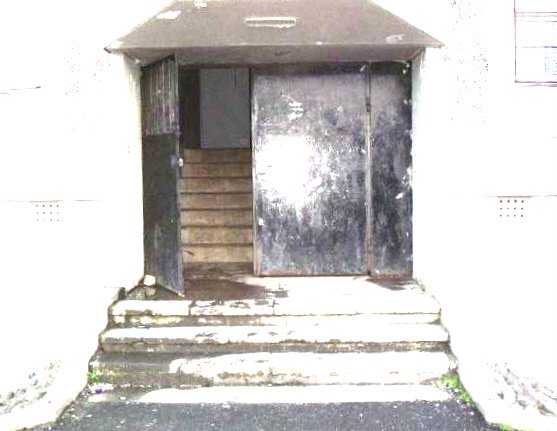
I have a Vision of The Future, chum,
The workers' flats in fields of soya beans
Tower up like silver pencils, score on score
John Betjeman
No more will the wild wind that passes
Return, no more return.
James Joyce
Tuesday, February 12, 2008
Early apple blossom today

The vernal equinox is still more than a month away—

but the blossom is well and truly out—

on a row of trees in the park behind Willesden sports centre.
Onion Mbeke Sphagnum
Monday, February 11, 2008


Sunday, February 10, 2008
Park life, February

Early wildflowers

People playing football

A longer view
That's the Capital City Academy in the left background, which looks like a stainless steel building, and is really huge. The other buildings in the background are the Willesden sports centre (also new), then Tarranbrae and then Donnington Court (with the wavy roof - also new). Just round the corner is the new community hospital and the entire neighbourhood has been re-paved. Does some government minister live around here, or what; surely it can't all be to try and win back Sarah Teather's seat in parliament? Anyway, about ten future generations are probably in hock for all this under PFI. If you don't know what that is, don't worry, it's really boring.
Feargal Mooney Sphagnum
Big names who didn't make the cut this year
It's not true that there was a story by Katherine Mansfield sent in, or rather that would seem to be a kite flown by one of our commenters in a teasing and jocular vein. I don't think Ms Mansfield has a workable email, under the rules, and seances are at best unreliable.
I think I have read all of KM's marvellous stories, seen and heard them performed, for example at last year's Small Wonder short story festival—a marvellous production of stories dramatised from "In A German Pension" with Andrew Sachs, the divine Eleanor Bron etc. I've read "Bliss and Other Stories" so many times that the old paperback copy on my shelf is falling to bits.
Regretfully the entries from Hemingway, Nabokov, Carver, and Italo Calvino had to be disqualified on account of the authors being dead (in spite of representations that Raymond Carver's editor had cut the heart out of his work first time round). Most painfully, for me personally, Frank O'Connor too.
For next year, we will try to clarify the rule about the non-eligibilty of posthumous entries. In any case it appears that the entries in some of these cases did not represent their finest work.
Ossian
I think I have read all of KM's marvellous stories, seen and heard them performed, for example at last year's Small Wonder short story festival—a marvellous production of stories dramatised from "In A German Pension" with Andrew Sachs, the divine Eleanor Bron etc. I've read "Bliss and Other Stories" so many times that the old paperback copy on my shelf is falling to bits.
Regretfully the entries from Hemingway, Nabokov, Carver, and Italo Calvino had to be disqualified on account of the authors being dead (in spite of representations that Raymond Carver's editor had cut the heart out of his work first time round). Most painfully, for me personally, Frank O'Connor too.
For next year, we will try to clarify the rule about the non-eligibilty of posthumous entries. In any case it appears that the entries in some of these cases did not represent their finest work.
Ossian
Saturday, February 09, 2008


Crescent moon tonight

"We΄re all in the gutter, but some of us are looking at the stars." (Oscar Wilde)
I know I didn't quite capture it, but in a way [alert! we have wistful sentiment incoming. ed.] the moon should not be captured.
Ossian
Friday, February 08, 2008
Verdict of the BK massive
a statement from pretend genius
dear readers of this exceptional piece of internet space,
i'd like to have a word with some of you so-called writers. a fireside chat, if you will, on why the various entries that i, in my dead state, did read and why they were not up to—yes, you know the word. i re-translated my thoughts from english and put them here to you in order to effectively communicate what makes gooder writing with the hope that you all will understand why we (pretend genius) agreed with the judgement of the judger of this contest.
the dramatic judgment and the ensuing humanicus dumbassicus vitriolicus (yes, i speak portuguese) that followed has inspired me (dead henry) to issue forth observations on gooder writing. i (still dead henry) have from time to time been known to offer something or other to those who seek it. not all of this something or other is understandable, however, and based on the cloistered nature of the human brain (meaning yours) this is not surprising. but due to my philoprogenitive nature i shall rise above the tendency of most 'writers' to horde and shall therefore generously particularize the monads of gooder writing for you in this introduction in the hopes that you will accept the judgement and move on with your so-called lives.
i. addressing the fundamental flaws in your approach
- the notion that gooder writing can be learned is false.
- the notion that reading can help you become a gooder writer is false.
- the notion that 'workshopping' can make you a gooder writer is false.
- the notion that feelings (suffering, love, happiness, grief, the 'heart') is the birthplace of gooder writing is false.
- the notion that the telling of a good story comprises gooder writing is false.
- the notion that mastery of language produces gooder writing is false.
if you believe that any of these notions have actually helped you to become a gooder writer, i assure you the connection (perceived) is coincidental. in short, everything you have thus far believed as it relates to gooder writing is false. once you have purged your quill of these dumbass beliefs you will be ready to work on your bow.
ii. observation is what goes in, it's something else entirely that comes out
were you a gooder writer this would be perfectly clear to you. but since you are not i shall make it crystal clear.
what one observes should not also be what one relates. a blue bird, for example, once recorded by the brain, should not then be preserved by that brain for the purpose of recitation. the recordation of the blue bird should serve as a template that will become sublimated, transformed, coalesced (with x), enhanced. i shall call this the 'alchemization' of the blue bird. this, like observation, is an involuntary reflex of the limited human brain that requires little of its already teenie-weenie functional capacities.
should someone observe a blue bird only to recite 'blue bird' or 'flying blue thing with some other sharp pointy thing on its head' we can say that what that someone is reciting is the original recordation of the blue bird which served as the brain's template. this is non-fiction/journalism crap and does not comprise gooder writing. the alchemization of the blue bird, although complete, is inaccessible to this someone (you).
iii. the two necessary events following alchemization that bring about the effect known as gooder writing
although the involuntary alchemization of what one observes provides the stuff of gooder writing, the ability to access this stuff without de-alchemizing it or un-transforming it is what separates gooder 'writers' from less gooder 'writers'. it is therefore necessary that two events occur following alchemization:
1. the destruction of the original recordation that served as the template from which the alchemization occurred.
the destruction of the original template launches the mind into a realm known as 'imagination'. the destruction of this template can also be called 'letting go'. i'll note for you, although it should be obvious, that the 'letting go' does not occur prior to the alchemization, nor is the 'letting go' necessary for the alchemization to occur. the letting go or destruction of the original template facilitates the accessing of the alchemization from the area where the alchemization occurred (the imagination). should the original template not be completely destroyed, the effects produced would be similar to dada or beat as the mind is still hanging by one arm, so to speak, from the partially undestroyed original template. the mind, in turn, wanting to let go but not having the courage to completely let go produces writing based on this awareness, which resembles something that may have been the effect of this 'letting go' but in reality is an effect produced by wanting to let go, being afraid to let go, not wanting anyone to know you are afraid to let go, and finally not being able to let go. this is not gooder writing. what what? no, what's more, 'letting go' artificially by some external means is also evidence of the lack of courage necessary to let go. this also depreciates the original template, for even though the original template must eventually be destroyed, seeing it as it is is vital to its alchemization. this type of artificial letting go also produces royal crapola.
the destruction ('letting go') of the original recordation that served as the template from which the alchemization occurred is the most difficult and important part of gooder writing. should one not destroy the original recordation or 'let go', the ability to access the alchemized blue bird in the 'imagination' is impossible. it may seem like a simple thing to do but i assure you (yet again (peasants)) that less than 1% of 1% of the entire human population, present and past, has ever had the ability to 'let go' for the purpose of producing gooder writing.
2. the accessing of the alchemization of the original recordation.
once one has 'let go', the ability to access the alchemization of the original recordation is academic. it is not a matter of how this accessing occurs, just as it is not a matter of how one gets wet in the ocean. it simply occurs.
in conclusion re: the introduction
it is my hope that with this basic introduction to gooder writing that most of you will see the futility of attempting it and give up completely, therefore assuring these dead eyes that they will not see anything that is not gooder writing. if, however, you wish to 'hope against all hope', a more nuanced elaboration of this introduction might follow. though i doubt any of you dumbasses will get it.
dead henry
i'd like to have a word with some of you so-called writers. a fireside chat, if you will, on why the various entries that i, in my dead state, did read and why they were not up to—yes, you know the word. i re-translated my thoughts from english and put them here to you in order to effectively communicate what makes gooder writing with the hope that you all will understand why we (pretend genius) agreed with the judgement of the judger of this contest.
the dramatic judgment and the ensuing humanicus dumbassicus vitriolicus (yes, i speak portuguese) that followed has inspired me (dead henry) to issue forth observations on gooder writing. i (still dead henry) have from time to time been known to offer something or other to those who seek it. not all of this something or other is understandable, however, and based on the cloistered nature of the human brain (meaning yours) this is not surprising. but due to my philoprogenitive nature i shall rise above the tendency of most 'writers' to horde and shall therefore generously particularize the monads of gooder writing for you in this introduction in the hopes that you will accept the judgement and move on with your so-called lives.
i. addressing the fundamental flaws in your approach
- the notion that gooder writing can be learned is false.
- the notion that reading can help you become a gooder writer is false.
- the notion that 'workshopping' can make you a gooder writer is false.
- the notion that feelings (suffering, love, happiness, grief, the 'heart') is the birthplace of gooder writing is false.
- the notion that the telling of a good story comprises gooder writing is false.
- the notion that mastery of language produces gooder writing is false.
if you believe that any of these notions have actually helped you to become a gooder writer, i assure you the connection (perceived) is coincidental. in short, everything you have thus far believed as it relates to gooder writing is false. once you have purged your quill of these dumbass beliefs you will be ready to work on your bow.
ii. observation is what goes in, it's something else entirely that comes out
were you a gooder writer this would be perfectly clear to you. but since you are not i shall make it crystal clear.
what one observes should not also be what one relates. a blue bird, for example, once recorded by the brain, should not then be preserved by that brain for the purpose of recitation. the recordation of the blue bird should serve as a template that will become sublimated, transformed, coalesced (with x), enhanced. i shall call this the 'alchemization' of the blue bird. this, like observation, is an involuntary reflex of the limited human brain that requires little of its already teenie-weenie functional capacities.
should someone observe a blue bird only to recite 'blue bird' or 'flying blue thing with some other sharp pointy thing on its head' we can say that what that someone is reciting is the original recordation of the blue bird which served as the brain's template. this is non-fiction/journalism crap and does not comprise gooder writing. the alchemization of the blue bird, although complete, is inaccessible to this someone (you).
iii. the two necessary events following alchemization that bring about the effect known as gooder writing
although the involuntary alchemization of what one observes provides the stuff of gooder writing, the ability to access this stuff without de-alchemizing it or un-transforming it is what separates gooder 'writers' from less gooder 'writers'. it is therefore necessary that two events occur following alchemization:
1. the destruction of the original recordation that served as the template from which the alchemization occurred.
the destruction of the original template launches the mind into a realm known as 'imagination'. the destruction of this template can also be called 'letting go'. i'll note for you, although it should be obvious, that the 'letting go' does not occur prior to the alchemization, nor is the 'letting go' necessary for the alchemization to occur. the letting go or destruction of the original template facilitates the accessing of the alchemization from the area where the alchemization occurred (the imagination). should the original template not be completely destroyed, the effects produced would be similar to dada or beat as the mind is still hanging by one arm, so to speak, from the partially undestroyed original template. the mind, in turn, wanting to let go but not having the courage to completely let go produces writing based on this awareness, which resembles something that may have been the effect of this 'letting go' but in reality is an effect produced by wanting to let go, being afraid to let go, not wanting anyone to know you are afraid to let go, and finally not being able to let go. this is not gooder writing. what what? no, what's more, 'letting go' artificially by some external means is also evidence of the lack of courage necessary to let go. this also depreciates the original template, for even though the original template must eventually be destroyed, seeing it as it is is vital to its alchemization. this type of artificial letting go also produces royal crapola.
the destruction ('letting go') of the original recordation that served as the template from which the alchemization occurred is the most difficult and important part of gooder writing. should one not destroy the original recordation or 'let go', the ability to access the alchemized blue bird in the 'imagination' is impossible. it may seem like a simple thing to do but i assure you (yet again (peasants)) that less than 1% of 1% of the entire human population, present and past, has ever had the ability to 'let go' for the purpose of producing gooder writing.
2. the accessing of the alchemization of the original recordation.
once one has 'let go', the ability to access the alchemization of the original recordation is academic. it is not a matter of how this accessing occurs, just as it is not a matter of how one gets wet in the ocean. it simply occurs.
in conclusion re: the introduction
it is my hope that with this basic introduction to gooder writing that most of you will see the futility of attempting it and give up completely, therefore assuring these dead eyes that they will not see anything that is not gooder writing. if, however, you wish to 'hope against all hope', a more nuanced elaboration of this introduction might follow. though i doubt any of you dumbasses will get it.
dead henry
Subscribe to:
Comments (Atom)